
The CMO’s Real Job Now: Connecting the Enterprise for Growth
Bronwyn Heys – CEO Australian Marketing Institute – January 2026
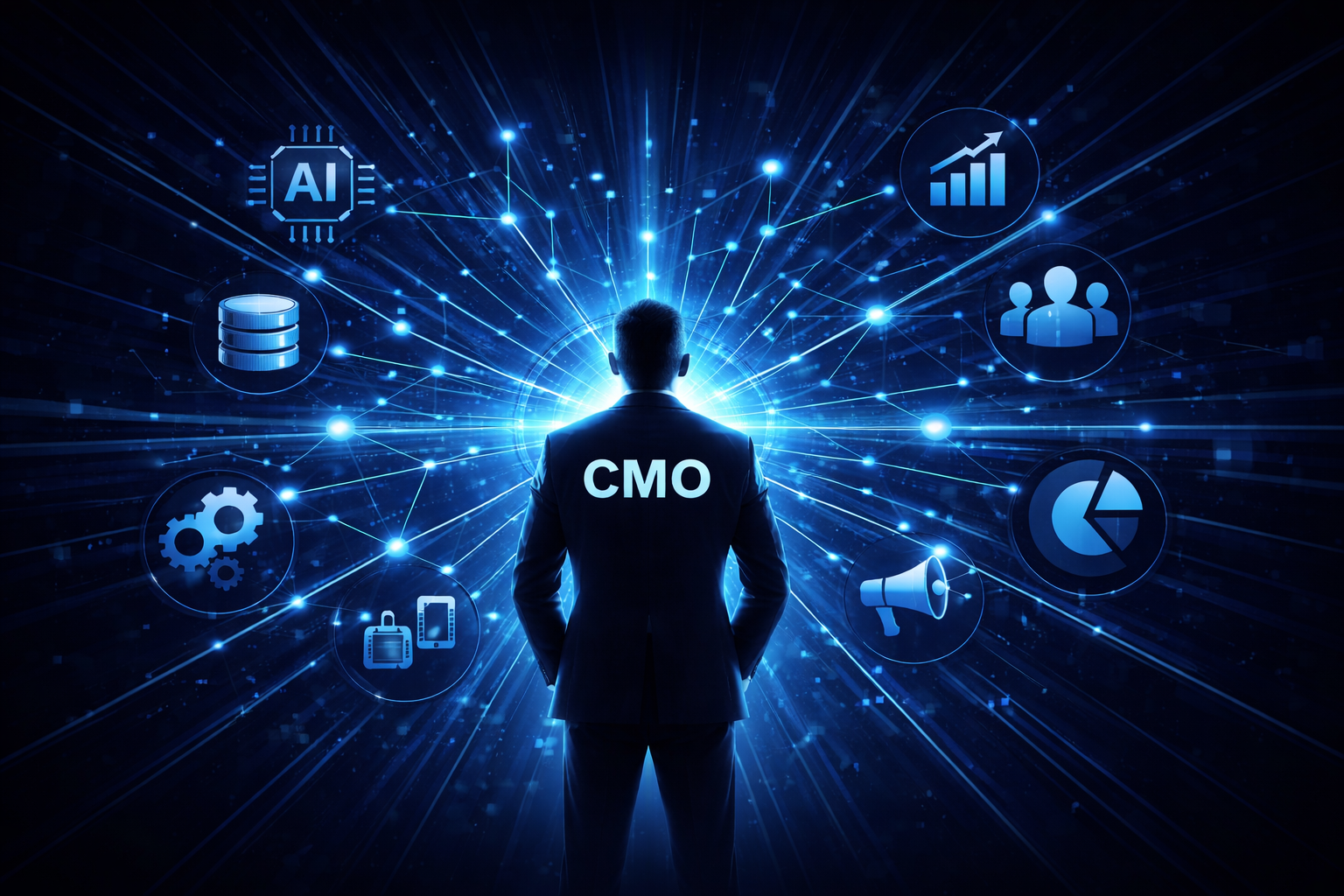
Over the next two years, the role of the Chief Marketing Officer will change more than it has in the past decade. Insights from a recent Macquarie University ANZMAC panel, combined with emerging industry research, point to a decisive shift: marketing leadership is moving from communications stewardship to enterprise orchestration. The future CMO will not be defined by campaigns, but by their ability to integrate technology, talent, data, and brand into commercial impact.
A central theme from the recent panel I sat on was, that CMOs must now “run the engine and rebuild the engine while driving at full speed.” That tension reflects the reality of AI adoption. CMOs are becoming orchestrators of AI, responsible not for tools, but for systems. Over the next two years, AI agents will increasingly automate content production, reporting, segmentation, and optimisation. This frees human capacity for higher-order work: diagnosis, insight, and strategy. The opportunity is scale and speed; the risk is fragmentation and misuse if AI is bolted on without governance or commercial intent.
This elevation of the role places commercial acumen at the centre of marketing leadership. Panel insights reinforced that CMOs who speak in activity metrics lose influence, while those who connect brand, demand, and capability to revenue and margin gain it. The “communication CMO” is rapidly becoming obsolete. In its place is a commercially fluent leader who understands pricing power, customer lifetime value, and growth economics, and can translate marketing investment into business outcomes with clarity and confidence.
Data-driven decision making underpins this shift, but not in a narrow, dashboard-driven sense. The next two years will see CMOs expected to integrate data across product, finance, operations, and customer experience to inform strategic choices. AI-enabled forecasting, experimentation, and scenario modelling will make marketing more predictive, but only if CMOs maintain rigorous diagnosis. As one industry critique notes, too many marketers still mistake tactics for strategy, skipping research and market understanding in favour of visible activity. The future belongs to leaders who reassert marketing’s analytical foundations.
Brand stewardship remains critical, but its meaning is expanding. Rather than being guardians of aesthetics, CMOs are increasingly custodians of long-term value and reputation. In volatile environments, brand acts as a stabiliser of trust, pricing power, and customer loyalty. Over the next two years, boards will expect CMOs to balance short-term performance with long-term brand equity, articulating the commercial cost of neglecting either.
Stakeholder management is therefore becoming more complex and more central to the role. CMOs must now operate horizontally, aligning with CFOs on value creation, CTOs on data and AI architecture, COOs on demand predictability, and CEOs on growth clarity. The panel emphasised that influence comes not from permission-seeking, but from providing strategic certainty. This demands exceptional collaboration and communication skills, particularly the ability to simplify complexity for senior audiences.
Organisational change management is another defining capability for the near term. AI, automation, and the rise of specialised roles have fragmented ownership of the customer. Over the next two years, CMOs will increasingly act as integrators, redesigning structures, workflows, and capability models. This includes leading hybrid teams that blend in-house talent, AI agents, and an expanding freelance marketing workforce. Freelancing is no longer a stopgap; it is becoming a strategic lever for access to scarce skills and rapid experimentation.
At the same time, marketing is experiencing a renaissance of customer experience. As automation handles execution, human effort shifts toward designing end-to-end journeys that feel coherent, personalised, and valuable. CMOs are uniquely positioned to connect customer insight with product innovation, service design, and growth strategy, provided they retain a systems mindset.
The implication is clear. Over the next two years, CMOs who succeed will look less like campaign managers and more like senior enterprise leaders. They will be commercially savvy, AI-literate, data-driven, and deeply collaborative. They will lead change, integrate fragmented capabilities, and protect long-term brand value while delivering short-term results. The title may evolve, but the mandate is strengthening: marketing leadership is moving from the margins to the core of organisational performance.
For CMOs, preparation now means investing in capability, redesigning operating models, and reclaiming strategic authority, ensuring marketing remains the function that sees the whole market and shapes growth rather than reacting to it with confidence globally.
For more information on how AMI can support you in this change see our AI Upgrade and training here – AMI AI Ugrade – AMI
Latest News
-

Why Professional Networking Is Essential for Your Career..
Why professional networking is essential to your career. We explore the types, benefits of professional networking and provide some tips to become an effective ...
-

The death of search, the fall of SaaS, the end of the web, t..
The marketing technology machine is being torn apart at the joints. According to legendary tech analyst and Forrester founder George Colony, we've just entered ...
-
Digital Australia 2024 report: Social media dominates as Tik..
A new report from Meltwater and We are Social shows hefty growth in social engagement on TikTok, ongoing loyalty to Facebook and significant advertising dollars...
-
Webinar: Strategic Networking..
Is Your Networking Just a Catch-Up Over Wine? Stop Wasting Your Time Networking! Learn networking fundamentals and how to measure your success. ...
-
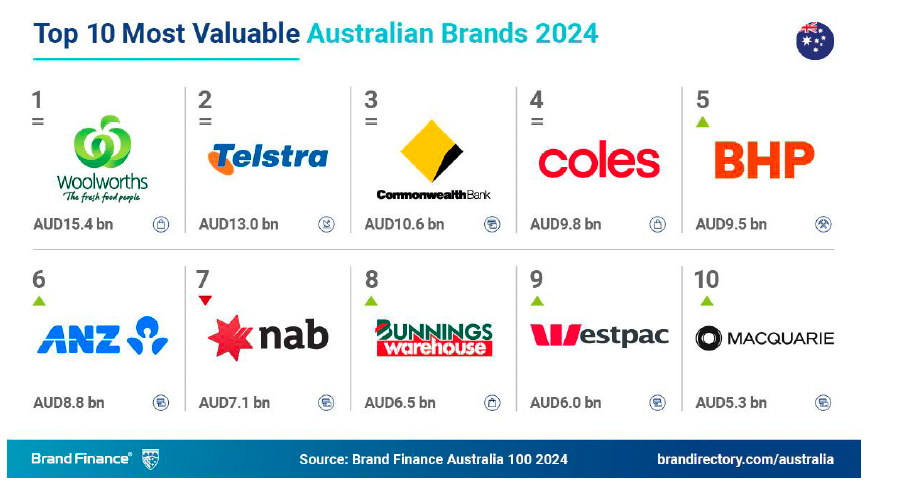
Brand Finance' most valuable 100 Australian brands 2024..
Brand Finance Australia has unveiled its 'Australia 100 2024' report, ranking the nation's 100 most valuable and strongest brands. The total valu...