
The marketer’s dilemma: what SXSW 2026 (Austin) taught us about trust, tools and staying relevant
AI is automating the edges of our work. That’s precisely why the centre, human judgement, earned trust, professional rigour, has never mattered more.
By Zeina Khodr · Founder, Paper + Spark · NSW State Chair, Australian Marketing Institute · 2022 Certified Practising Marketer of the Year
What would you do if the most important audience for your next campaign wasn’t human? That question asked only half-jokingly in a packed Austin auditorium is one that Australian marketers need to sit with seriously right now.
SXSW is not a typical industry event. It is a city-wide collision of technology, culture, media and ideas that has a track record of surfacing what matters before the mainstream catches on. When Twitter launched there in 2007, it didn’t just introduce a platform, it signalled that marketing could no longer be separated from the environments where audiences actually spend their time. SXSW now functions less as a showcase and more as an early indicator of where professional attention needs to go.
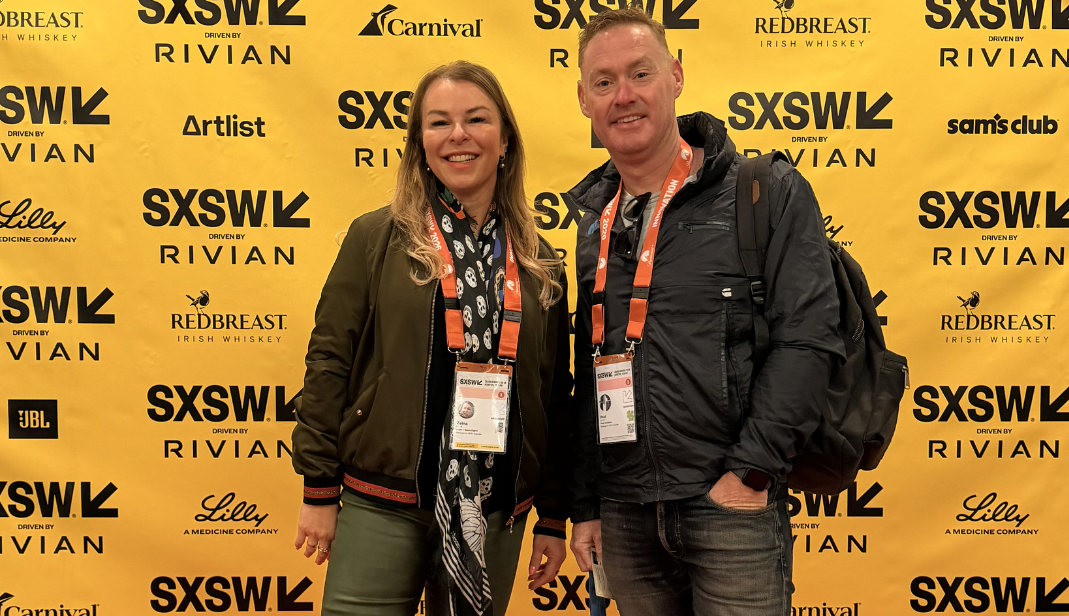
I made the trip to Austin this year alongside as both a marketer and as NSW Chair of the AMI, curious not just about what was new, but about what it means for our profession. My team also joined me for the experience, Paul Everson CPM (2024 CPM of the Year) and Suma Wiggins (CPM).
Here are five signals that I believe every Australian marketer should be responding to right now.
SIGNAL 01 – Your next customer might be an algorithm is your brand legible to it?
Futurist Amy Webb’s framing of a shift from “user experience” to “agentic experience” was one of the most debated ideas of the week.
AI agents are increasingly making the first pass at decisions, researching, comparing and shortlisting options before a person becomes directly involved. Discovery is being mediated by systems acting on someone’s behalf.
For marketers, this changes the nature of the game. We have spent decades optimising for how a brand is perceived by a person. We now need to also ask: how is it interpreted by a system? Credibility signals, structured data, schema markup and consistency of brand information across the web are becoming the new first impression, not just for search rankings, but for AI citation and recommendation.
In Australia, this shift is already visible. Google’s AI Overviews are reshaping how brands appear in search results. Tools like Perplexity are changing how younger Australians research financial products, health decisions and purchase choices. The emerging discipline of Generative Engine Optimisation — GEO — is becoming as strategically important as SEO was in 2010. Most Australian marketing teams are not yet resourced for it.
THE MARKETER’S ACTION
Audit whether your brand is legible to AI discovery systems, not just human searchers. Check structured data, schema markup, and whether authoritative third-party sources are citing your brand consistently. If your organisation doesn’t have a GEO strategy, it needs one.
FOR THE PROFESSION
GEO literacy should be part of CPM assessment criteria. The AMI is setting the standard on this before other bodies do, the same way we helped define digital measurement practice a decade ago.
Signal 02 – Authenticity is no longer a brand value, it’s a competitive advantage
For a festival so dominated by technology, it was striking how often the conversations returned to human qualities. Sessions from Brené Brown and organisational psychologist Adam Grant drew some of the largest crowds of the week and the appetite in that room said something important about what people are genuinely hungry for.
As AI-generated content floods every channel, audiences are becoming more sensitive to what feels authored versus generated. The threshold for what passes as considered communication is rising rapidly. For marketers, this is not a creative preference, it is a strategic one.
We see this playing out in Australia already. Eucalyptus, the company behind Pilot, Kin and Software has built category-defining brands in health by communicating with genuine directness about complex topics. Koala disrupted furniture retail not just with product, but with a voice that felt like a real person talking. In contrast, the wave of AI-assisted content filling LinkedIn and brand blogs is already training audiences to skim and filter. The brands winning attention are the ones that feel like they have something to say.
For marketers in trust-sensitive categories, financial services, healthcare, professional services, government this is especially acute. Generic content doesn’t just underperform. It actively erodes the credibility that took years to build.
THE MARKETER’S ACTION
Audit your last six months of content. What percentage could have been written by any brand in your category? Where is the point of view, the lived experience, the genuine expertise? It’s tempting and almost expected to use AI to move faster, but ensure a human with real knowledge and authority is shaping what it says.
FOR THE PROFESSION
The CPM designation exists precisely to signal credentialled, practising expertise. In an era of AI-generated thought leadership, the value of a verified human expert is increasing and the AMI is committed to communicating this more loudly to both members and the organisations that hire them.
Signal 03 – AI is now the operating environment, the question is how well you’re working within it
Across SXSW, AI was not being introduced or debated. It was assumed. The conversation has shifted from “should we adopt AI?” to “how effectively are we integrating it, and where is it widening the gap between organisations that are moving and those that aren’t?”
That gap is real and it is widening. In Australian marketing teams right now, AI is already being used to generate creative briefs and campaign concepts (ChatGPT, Claude, Gemini), to optimise media spend in near-real time (Meta Advantage+, Google Performance Max), to replace manual audience segmentation with predictive modelling, and to QA content at a scale no human team could manage. Synthetic audiences to substitute market research are taking off. Teams that have embedded these tools are producing more, faster, at lower cost. Teams still evaluating are falling behind.
The more important question emerging from SXSW is not whether to use AI, but how to use it without losing what makes your work distinctive. Riding in a Waymo autonomous vehicle across Austin (almost the default uber option) smooth, efficient, very unnerving was a useful metaphor. The technology is impressive. But someone still had to design where it goes and get it out of an occasional jam (as we experienced on a couple of rides!).
THE MARKETER’S ACTION
Map where AI is already inside your marketing stack, you may have more than you think through platforms like Meta, Google and your CRM. Then identify the one highest-friction workflow your team still does manually that AI could assist with. Start there. Also look at how Coles 360 and Woolworths Everyday Rewards are operationalising first-party data as third-party cookies disappear, retail media is a leading indicator for the whole industry.
FOR THE PROFESSION
AI literacy is no longer optional for practising marketers. The AMI’s ongoing work on AI standards is exactly the kind of professional infrastructure our industry needs, but awareness among members needs to increase.
Signal 04 – Visibility is no longer free, your audience is choosing to disappear
Not all of the shifts at SXSW were loud. Running through several sessions was a quieter but significant change in how people are choosing to engage with digital life. After years of compulsive sharing, there are clear signs of a recalibration, particularly among younger audiences who are redefining what public presence means to them.
Experiences not designed to be documented are becoming more common. Boundaries around visibility and participation are being re-established, not as a rejection of digital platforms, but as a more deliberate relationship with them. In Australia, we see this in the rise of phone-free venues (nightclub Chinese Laundry uses stickers to cover mobile phone cameras on entry to encourage engagement)., renewed enthusiasm for analogue experiences, print, vinyl, physical retail and research showing Gen Z increasingly uses social media for discovery rather than documentation.
For brands, this fundamentally shifts the logic of content strategy. Volume and frequency as a reach strategy is running into diminishing returns. Presence needs to be earned through context, relevance and genuine value, not assumed through volume.
THE MARKETER’S ACTION
Review your content calendar with one question: if your audience chose not to see this, what would they be missing? If the honest answer is “not much,” the problem isn’t the algorithm. Consider investing in fewer, more considered pieces of content and channels where attention is still given, not scrolled past.
Signal 05- One consumer, two modes and marketers need to design for both
A recurring theme across SXSW was the emergence of what might be described as a two-speed consumer. On one hand, a continued move toward frictionless automation, subscription renewals, AI-assisted financial decisions, automated replenishment. Routine choices handled with minimal involvement.
On the other, a growing appetite for experiences that feel intentional, tangible and worth showing up for. In Australia, this is visible in the recovery of experience-led retail, brands like Mecca, Bunnings and the Apple Store are investing in physical environments that offer something genuinely beyond transaction. Heap’s Normal (non-alc beer) have just opened their first Health Club in Marrickville Sydney to rethink and reshape what ‘wellness’ means, focusing on connection, creativity and play as fundamental. The same consumer who auto-renews their streaming subscription will travel across the city for an experience worth having.
The insight is not that one mode wins. It is that the same person operates in both and expects brands to know which one they are in. Marketers who design only for efficiency will lose on experience. Those who design only for experience will frustrate at the transactional end. The skill is in reading the context.
THE MARKETER’S ACTION
Map your customer journey against these two modes. Where are you asking for attention when people want efficiency? Where are you offering efficiency when people want engagement? The gap between those two is often where dissatisfaction quietly builds.
What this means for the marketing profession
The cumulative picture from SXSW is of a profession under genuine pressure to evolve, not because the fundamentals have changed, but because the environment has. Credibility, relevance and human connection remain at the centre of effective marketing. What has changed is how much harder they are to earn, and how quickly the tools available to earn them are moving.
For Australian marketers, the question is not whether to engage with AI, agentic systems or shifting audience behaviour. It is how to do so with enough professional rigour and human judgement to make the work actually matter.
That is exactly what professional development, CPM accreditation and the AMI community exists to support. The signals from Austin are clear and the marketers best placed to respond are the ones who combine current capability with a foundation of genuine expertise.
If you’d like to discuss what any of these themes mean for your organisation or team, I’d welcome the conversation. Connect via Linkedin or reach out directly through Paper + Spark.
Latest News
-

Why Professional Networking Is Essential for Your Career..
Why professional networking is essential to your career. We explore the types, benefits of professional networking and provide some tips to become an effective ...
-

The death of search, the fall of SaaS, the end of the web, t..
The marketing technology machine is being torn apart at the joints. According to legendary tech analyst and Forrester founder George Colony, we've just entered ...
-
Digital Australia 2024 report: Social media dominates as Tik..
A new report from Meltwater and We are Social shows hefty growth in social engagement on TikTok, ongoing loyalty to Facebook and significant advertising dollars...
-

Webinar: Strategic Networking..
Is Your Networking Just a Catch-Up Over Wine? Stop Wasting Your Time Networking! Learn networking fundamentals and how to measure your success. ...
-
Brand Finance' most valuable 100 Australian brands 2024..
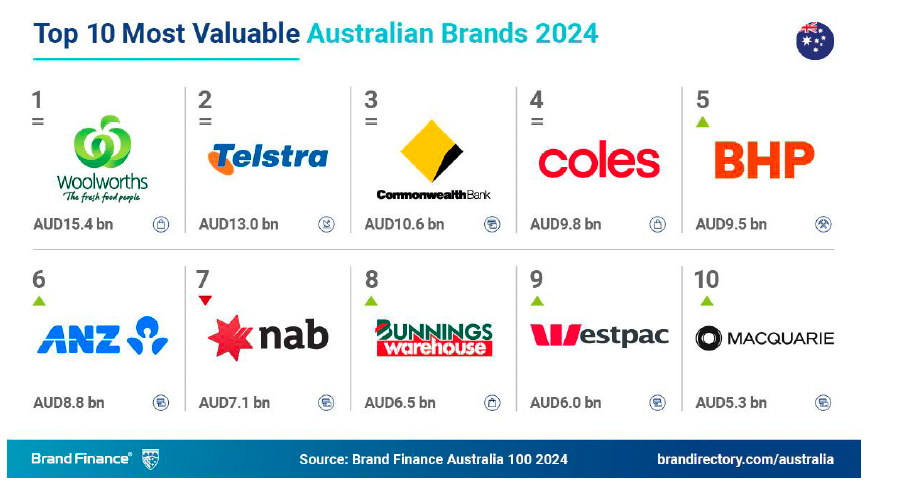
Brand Finance Australia has unveiled its 'Australia 100 2024' report, ranking the nation's 100 most valuable and strongest brands. The total valu...